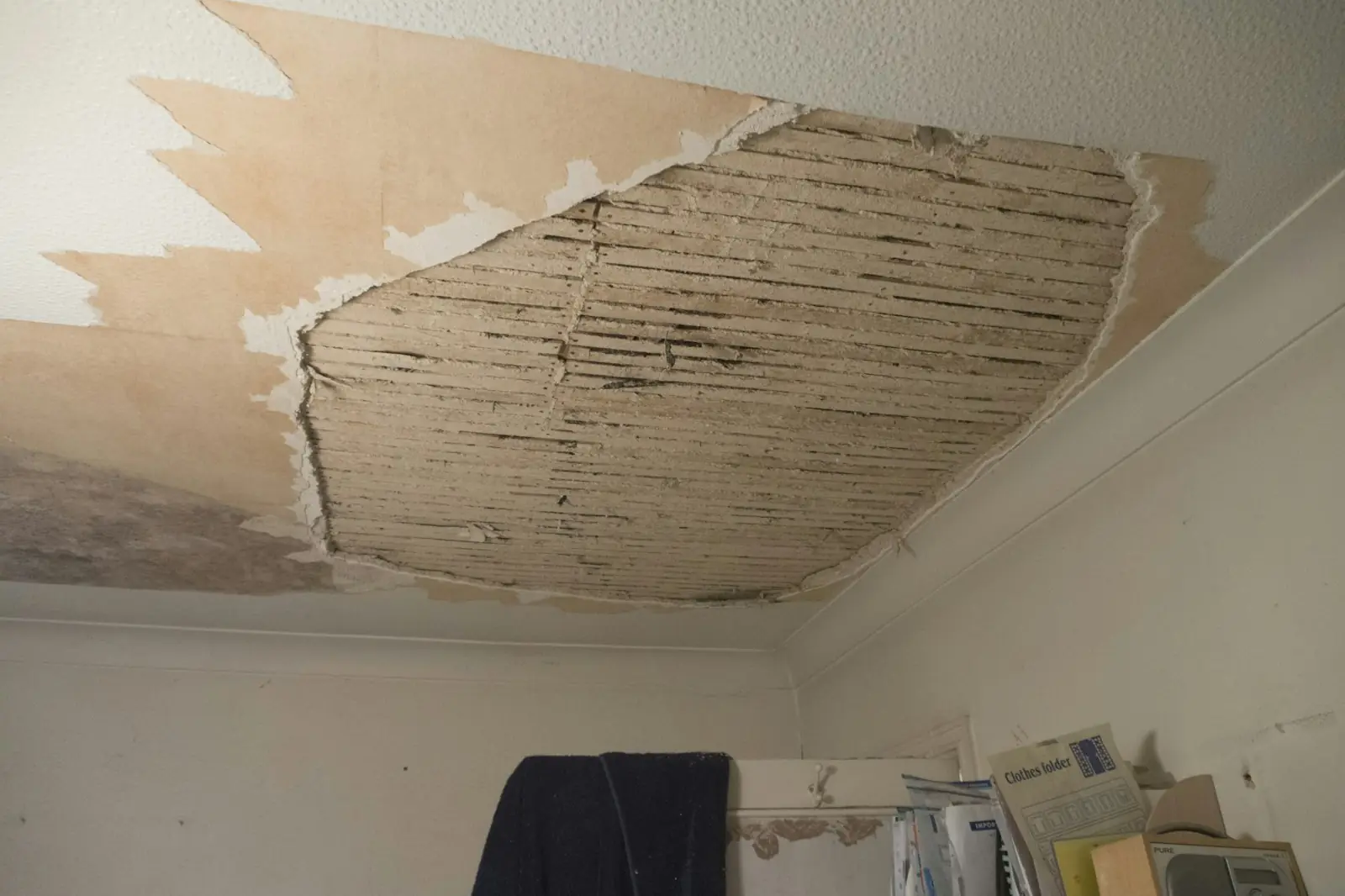
In a stacked building, a ceiling leak is almost never about your apartment. It’s the tub upstairs, a cracked stack in the wall, or a flat roof that’s been ponding since the last storm. You still have to live under it — so here’s what to do, what we do, and who should be paying.
Is it safe? Check these first
- A bulging or sagging ceiling is holding water and can come down. Get people, pets and valuables out from under it. Put a bucket and a tarp below, and don’t poke it with anything while standing underneath.
- Water coming through a light fixture or near outlets — don’t touch the switch. Shut the breaker for that room only if you can reach the panel from a dry spot.
- Cracking sounds or chunks of plaster falling — leave the room and call.
Where the water is coming from
| Source | Clues | Water category |
|---|---|---|
| Upstairs tub, shower or sink overflow | Sudden heavy drip, often under the bathroom above | Usually clean or gray |
| Upstairs toilet overflow | Under the bathroom above, may smell | Gray — or sewage if solids were in it |
| Cracked waste stack in the wall | Recurring stain near the bathroom wall, smell, worse when people upstairs use the plumbing | Sewage (Category 3) |
| Supply riser or radiator line | Steady flow, may be warm, can run several floors | Clean at first |
| Roof, parapet or skylight | Top floor, gets worse with rain or snowmelt | Usually clean or gray |
| Washer, dishwasher or AC condensate upstairs | Under a kitchen, laundry area or window unit | Usually gray |
Why did my neighbor’s leak show up in a different room?
Water rarely drops straight down. It runs along pipes, joists and the top of the ceiling below until it finds a low spot or an opening — a light fixture, a crack, a corner. A leak under the bathroom upstairs can show up over your hallway or kitchen.
Plaster ceilings need a different approach
Most pre-war apartments in Mott Haven have plaster on wood lath, not drywall. Plaster holds water much longer, it gets heavy, and the keys that hold it to the lath can let go. That changes the job:
- We check how much water is sitting on top of the ceiling, not just how wet the paint is.
- If water is pooled above it, a small controlled opening to drain it can save the rest of the ceiling.
- We dry it slowly. Plaster dried too hot and too fast cracks and drops.
- Sections that have lost their grip on the lath may have to come down for safety — we tell you before we touch them.
How we handle a ceiling leak
- Make the room safeProtect people and belongings under the leak; deal with sagging areas and electrical first.
- Find the source with the superWe trace it to the apartment, the wall or the roof so it can be stopped. Fixing the pipe or roof is a plumber’s or roofer’s job.
- Map the spreadThermal camera and moisture meters on the ceiling, walls and floor — in your apartment and the one below.
- Extract and relieveGet standing water off the floor and out of the ceiling cavity.
- Dry the ceiling and wallsDehumidifiers and air movers placed for the ceiling, with readings every visit.
- Document itPhotos, readings and a written report you can hand to your landlord, the upstairs neighbor or an insurer.
Who pays for a ceiling leak in an NYC apartment
- Your landlord fixes your ceiling. The building has to keep your apartment livable, whether the water came from the roof, the pipes or the neighbor’s tub. A leak is the landlord’s responsibility unless you damaged the plumbing yourself.
- Your belongings are usually covered by your renters insurance. If the upstairs neighbor was negligent — left the tub running, ignored a leaking hose — you may be able to recover from them or their insurer.
- Put it in writing. Text or email the super and landlord with photos and the time it started. If nothing happens, call 311 to file a complaint with HPD.
Your full rights as a renter after a leak →
What ceiling leak cleanup costs
A ceiling leak from clean water, caught early, typically runs $650 – $1,800 for one room. If the water is gray or sat for a while, $1,200 – $4,000. Sewage from a cracked stack is Category 3 and priced as a sewage job. You get a written estimate before we start. Cost guide →
Ceiling leak FAQs
Is a water stain on my ceiling an emergency?
A dry, old stain isn’t. A stain that’s growing, feels damp, is sagging or is dripping is — water is still coming in, and the ceiling can fail. Tell the super right away and call us if it’s active.
Should I poke a hole in a bulging ceiling?
Only if it’s safe and you’re not standing under it — and a professional is the safer choice. The water has to come out somewhere, and a controlled opening over a bucket is better than the whole ceiling dropping. If you can’t do it safely, keep everyone out of the room and call.
My upstairs neighbor flooded my apartment. Who fixes it?
Your landlord fixes your apartment. Who pays for your damaged belongings depends on what caused the leak and whether the neighbor was negligent. Film the leak and notify both the landlord and the neighbor in writing.
Can a wet ceiling grow mold?
Yes. Wet materials can start growing mold within 24–48 hours, and the space above a ceiling stays damp a long time. Drying it properly is how you prevent that.
Does a ceiling leak always mean tearing the ceiling down?
No. Many ceilings can be dried in place. Sections come down only if they’re saturated with sewage, sagging badly, or have lost their grip on the lath.